

Authority / Evidence Dossier · Last verified 3 September 2026
For the two main direct descent routes, the official Portuguese nationality fee is generally €175 for an adult attribution application and €0 when the attribution concerns a minor. That covers a person born abroad to a Portuguese parent and, where the statutory conditions are met, a grandchild of an original Portuguese citizen.
The headline fee is not the same as the total budget. Foreign civil records, apostilles or other legalisation, certified translations, consular acts and optional professional representation can add separate costs. A great-grandchild route is legally different again: under the current law, the Article 6(8) naturalisation route is not the same €175 attribution procedure.
The search phrase Portuguese citizenship by descent cost sounds as though Portugal has one price for everyone with Portuguese ancestry. It does not. The fee follows the legal procedure: attribution of nationality of origin, acquisition by declaration, or naturalisation. The current fee schedule therefore has to be read together with the current Nationality Law, especially after the May 2026 reform.
The competent authority for nationality is the Instituto dos Registos e do Notariado (IRN). Justice.gov.pt states that an applicant without a lawyer or solicitor may file by post or at a Nationality Counter, while a lawyer or solicitor acting as representative uses the online nationality channel. This is separate from AIMA residence procedures. If your question is really about residence rather than nationality, PortugalPath’s current permanent-residency cost guide explains that different system.
What “Citizenship by Descent” Means in Portuguese Law
“Citizenship by descent” is a useful English search label, but Portuguese law uses more specific categories. That distinction matters because the same family relationship can lead to a different legal route, evidence burden and official fee.
A person born abroad to a Portuguese mother or father can be Portuguese of origin under Article 1(1)(c), subject to the statutory registration or declaration route.
Article 1(1)(d) is also an attribution of nationality of origin, but it has its own ancestry and connection requirements.
Article 6(8) is a naturalisation route for a third-degree lineal descendant of an original Portuguese citizen who has at least five years of legal residence in Portugal. It is not direct attribution.
Article 2 concerns acquisition by declaration after the parent’s later acquisition. It should not be priced automatically as the child-of-a-Portuguese-parent origin route.
For cost purposes, the first two routes are the important pair. The current Registry and Notarial Fee Regulation sets €175 for an adult procedure involving registration of a foreign birth or attribution of Portuguese nationality. The same regulation separately makes attribution declarations and attribution registrations concerning a minor free.
This is why a generic website statement such as “Portuguese citizenship costs €250” is incomplete. €250 is the standard fee category for many adult acquisition or naturalisation procedures, not the general fee for an adult attribution claim through a Portuguese parent or qualifying grandparent.
Portuguese Citizenship by Descent Cost: The Current Official Fee Matrix
| Situation | Official baseline | Evidence category | Practical meaning |
|---|---|---|---|
| Adult born abroad to a Portuguese parent | €175 | Official fee regulation | Attribution / foreign-birth registration procedure concerning an adult. |
| Adult qualifying grandchild of an original Portuguese citizen | €175 | Official fee regulation | Also an attribution of nationality of origin when Article 1(1)(d) is satisfied. |
| Attribution concerning a minor | €0 | Official exemption | The fee regulation lists the relevant attribution declaration and registration acts concerning minors as free. |
| Adult naturalisation, where no special exemption applies | €250 | Official fee regulation | Relevant to routes such as Article 6(8), rather than direct adult attribution. |
| Nationality certificate, if separately requested | €50 | Official document fee | A separate certificate; it is not the citizenship application fee itself. |
The official fee regulation also states that, in a case of indeferimento liminar—summary rejection at the threshold stage—the nationality emolument remains due in full. Paying the application charge therefore does not purchase approval or a refundable reservation of a right.
The figures above are Portuguese official fees. They are not an “all-in package price.” A private adviser’s quote may legitimately be much higher because it can include legal analysis, document procurement, translation, certification, courier work or representation. Those items must be separated from the IRN fee before comparing providers.
Why the Total Can Be Higher Than €175
For an adult child or qualifying grandchild, €175 is the clean official starting point. The final spend depends heavily on where the family documents were issued and how complete the Portuguese civil-registration chain already is.
Foreign birth, marriage and parentage records
The Justice guide for a person born abroad to a Portuguese parent requires a legalised foreign birth certificate and explains that legalisation may be by apostille or Portuguese consular visa, depending on the document and country. The grandchild route can require the applicant’s birth certificate and the birth record of the intervening parent as well as the Portuguese grandparent’s record. If a Portuguese record can be identified in the national system, the authority may be able to obtain it itself rather than requiring the applicant to buy another copy.
Foreign registry authorities set their own certificate and apostille charges. There is no single Portuguese statutory price for those overseas documents, so an evidence-led budget should use the current fee of the issuing jurisdiction instead of a universal estimate.
Certified translation
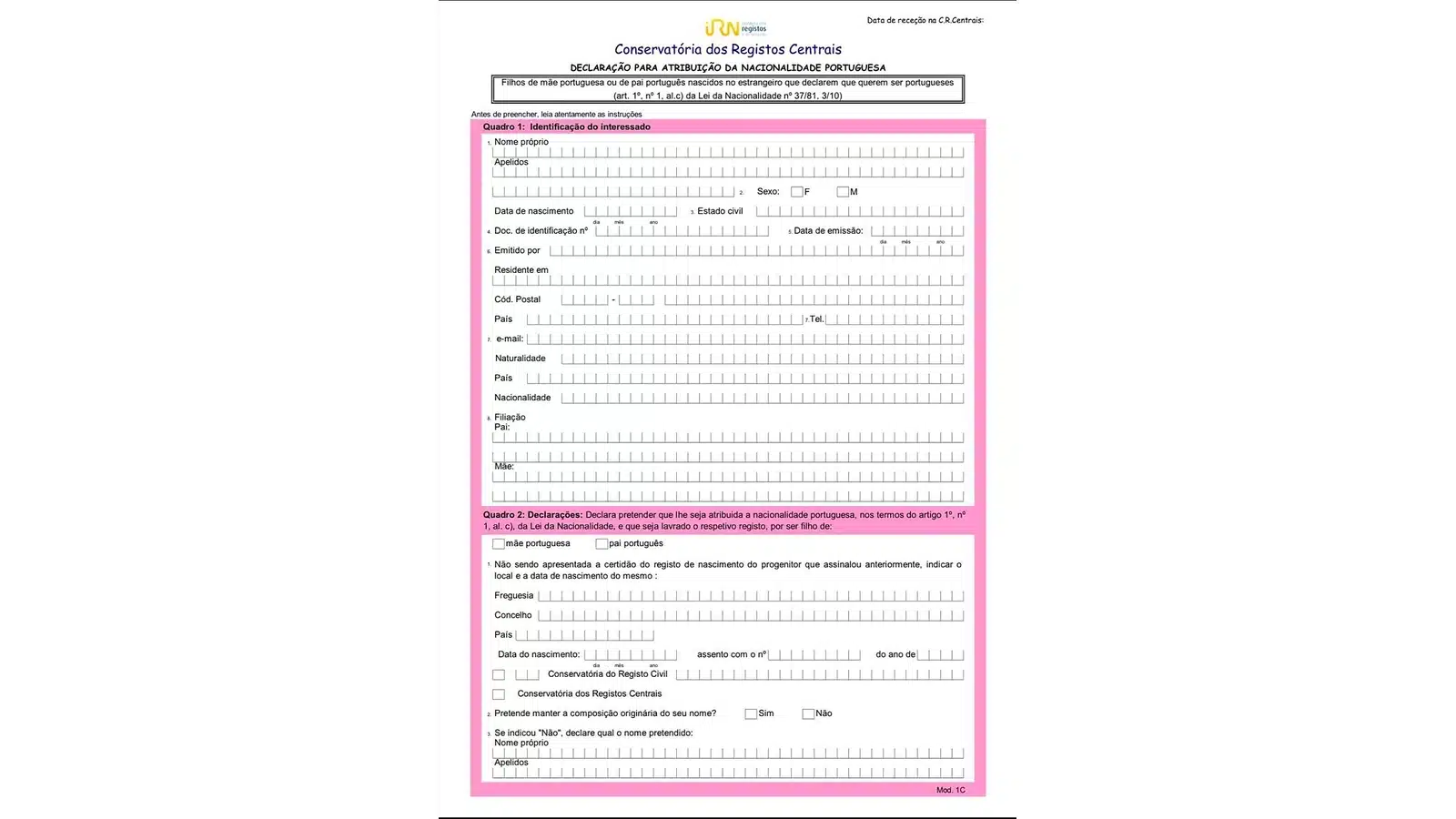
Current Justice guidance says foreign-language civil records may require certified translation into Portuguese. Translation cost is not included in the €175 nationality fee and varies by document length, language, country and provider. Old IRN forms can contain different wording about translation exemptions for documents in English, French or Spanish, which is another reason to use the current route guidance and not a downloaded form in isolation.
Consular charges can be a separate layer
Applicants living abroad may choose or need to deal with a Portuguese consular post. Portugal’s consular fee schedule contains separate nationality-related emoluments, including a charge for certain written declarations or procedural acts and a separate tariff for some foreign-birth registration procedures concerning adults. These consular amounts should not be automatically added to €175 in every case: the amount depends on what act the post actually performs. Confirm the competent consulate’s current instruction and tariff before paying.
Professional representation is optional, not an IRN fee
Justice.gov.pt does not make a private lawyer a blanket requirement for an ordinary self-filed nationality application. An unrepresented applicant can use post or a Nationality Counter. A lawyer or solicitor may still be valuable where the lineage is disputed, records conflict, parentage was established late, a previous nationality event affects the chain, or the 2026 law change creates a real interpretation problem. PortugalPath’s guide to immigration-lawyer consultations explains how to separate a professional fee from an official government charge.
The 2026 Grandchild Rule Changed — and Some Official Web Guidance Still Lags
This is the most important current-law issue for anyone researching Portuguese citizenship by descent cost through a grandparent. Organic Law 1/2026 took effect on 19 May 2026. It kept the grandchild route in Article 1(1)(d), but added a cross-reference requiring the conditions in Article 6(1)(c) to (h) for attribution under that paragraph.
For new grandchild applications after 19 May 2026
Required by current law: Article 1(3) now links the grandchild route to requirements concerning knowledge of Portuguese language and culture, history and national symbols; knowledge of fundamental rights and duties and the political organization of the Portuguese state; a solemn declaration of adherence to democratic rule-of-law principles; and the specified criminal, security and sanctions conditions.
Current official web guidance: the Justice grandchild guide, accessed on 3 September 2026, still describes the older framework in which effective connection is recognized through Portuguese-language knowledge and presents an older criminal-condition formulation.
Administrative implementation: the consolidated Nationality Regulation still shows its last amendment as 23 July 2025, even though the 2026 law instructed the Government to amend it within 90 days. The enacted statute is the stronger authority for new cases; the lagging guidance is evidence of an implementation gap, not an alternative legal rule.
There is also an explicit transition provision. Administrative procedures already pending when the new law entered into force continue under the previous wording. That means two apparently similar grandchildren can be governed by different substantive rules depending on whether their procedure was already pending on 19 May 2026. The €175 adult attribution fee remains a fee question; eligibility under the correct version of the law is a separate question.
For a person born abroad to a Portuguese parent, the basic origin rule in Article 1(1)(c) remains structurally simpler. The current Justice child-of-a-Portuguese-parent guide lists the identity, birth-record and Portuguese-parent record evidence and the available filing channels.
What About Great-Grandchildren?
Family trees are where cost articles often become misleading. A great-grandparent is a third-degree lineal ascendant. The current Article 6(8) allows naturalisation for people who are third-degree lineal descendants of original Portuguese citizens and who have at least five years of legal residence in Portugal. The paragraph dispenses with the ordinary residence-duration requirement in Article 6(1)(b), but it does not convert the case into the €175 grandchild attribution route.
For an adult using a naturalisation procedure without a special fee exemption, the fee schedule’s ordinary acquisition/naturalisation amount is €250. More importantly, Article 6(8) is not a stand-alone ancestry shortcut for someone living anywhere in the world: the statute itself requires at least five years of legal residence in Portugal. If a commercial service describes every Portuguese great-grandchild as having the same direct “citizenship by descent” route as a grandchild, ask for the exact legal provision.
This is also where residence and nationality planning can intersect. But paying residence fees for years and later paying a nationality fee are separate legal and financial events; one is not a prepayment of the other.
How to Budget the Application Without Inventing an “All-In” Number
A reliable Portuguese citizenship by descent cost budget can be built in layers. The point is not to predict every cent before the documents are known; it is to prevent official fees, foreign-document charges and private service prices from being mixed into one unexplained figure.
- Identify the legal route first. Child of a Portuguese parent, grandchild, third-degree descendant or child of someone who acquired nationality later are not interchangeable categories.
- Apply the age-based fee rule. For attribution, adult generally means €175; the official attribution acts concerning a minor are free.
- Map the civil-registry chain. List each foreign birth, marriage, divorce, name-change or parentage record that is actually needed to prove the lineage.
- Price document formalities by issuing country. Use the issuing authority’s current certificate and apostille/legalisation prices and obtain actual translation quotes where translation is required.
- Check the filing channel. Post, Nationality Counter, professional online submission and consular handling can create different operational or ancillary costs.
- Separate private fees. A lawyer, solicitor, genealogist, translator or document-retrieval company charges for a service. Ask for a written scope showing what is included and what remains payable to public authorities.
Need help organising a nationality-by-descent file?
PortugalPath can help you structure the document and process questions that need checking before you file. The IRN and other competent Portuguese authorities decide nationality applications, and no private provider can guarantee approval or processing time.
What to Verify Before Acting
- Your exact ancestor relationship: parent, grandparent and great-grandparent lead to different statutory routes.
- Whether the Portuguese ancestor was an original Portuguese citizen and whether nationality was lost: this is particularly material for the grandchild wording in Article 1(1)(d).
- The applicant’s age: it directly affects whether the attribution fee is €175 or falls within the minor exemption.
- The filing date of any existing grandchild case: a procedure pending on 19 May 2026 is covered by the transition rule preserving the earlier law.
- The current route checklist: Justice and IRN pages are still being updated after the 2026 reform, so reconcile operational guidance with the enacted law.
- Every quote you receive: label each line as IRN fee, consular fee, foreign record, apostille/legalisation, translation, postage or professional service.
The practical answer is therefore precise but conditional. For a straightforward adult attribution through a Portuguese parent or a qualifying Portuguese grandparent, the current official baseline is €175. If the applicant is a minor and the case is an attribution procedure, the relevant official acts are free. The total can still rise because of supporting records and optional services, while more remote ancestry may move the case into a different legal route and fee category altogether.
If you are comparing this route with nationality based on being born in Portugal, see PortugalPath’s evidence-led guide to Portuguese citizenship by birth costs, which explains the separate minor and birth-registration rules.
Related PortugalPath Guides
Sources and Verification
| Source | Institution | What was verified | Access date |
|---|---|---|---|
| Organic Law 1/2026 | Diário da República | Current child, grandchild and third-degree descendant provisions; 19 May 2026 effective date; grandchild cross-reference; transition rule. | 3 Sep 2026 |
| Registry and Notarial Fee Regulation, Article 18 | Diário da República | €175 adult attribution; €250 adult acquisition/naturalisation; €50 nationality certificate; full fee due on summary rejection. | 3 Sep 2026 |
| IRN Costs of Services | IRN | Free attribution declarations and registrations concerning minors; current registry fee framework. | 3 Sep 2026 |
| Submit a nationality application and apply by post | Justice / IRN | Current filing channels, professional online submission, self-filing by post or counter, and the payment process for postal applications. | 3 Sep 2026 |
| Child of a Portuguese parent and grandchild guide | Justice / IRN | Current published document guidance and the post-reform mismatch between the grandchild web guide and enacted law. | 3 Sep 2026 |
| Portuguese Nationality Regulation | Diário da República | The consolidated regulation still displays 23 July 2025 as its last amendment after the May 2026 statutory reform. | 3 Sep 2026 |
| Consular Emoluments Regulation | Diário da República | Separate consular tariffs exist for specified nationality procedural acts and certain foreign-birth registration services. | 3 Sep 2026 |
Evidence note: no stock or illustrative images were used. Current fees were checked against the official registry fee regulation, and the May 2026 nationality reform was reconciled against current Justice guidance. This article provides general information, not individualized legal advice.
Photo credit: Rakoon, 10 June 2023 — Source: Wikimedia Commons — License: Public domain (PD-text; PD-Portugal-exempt)