
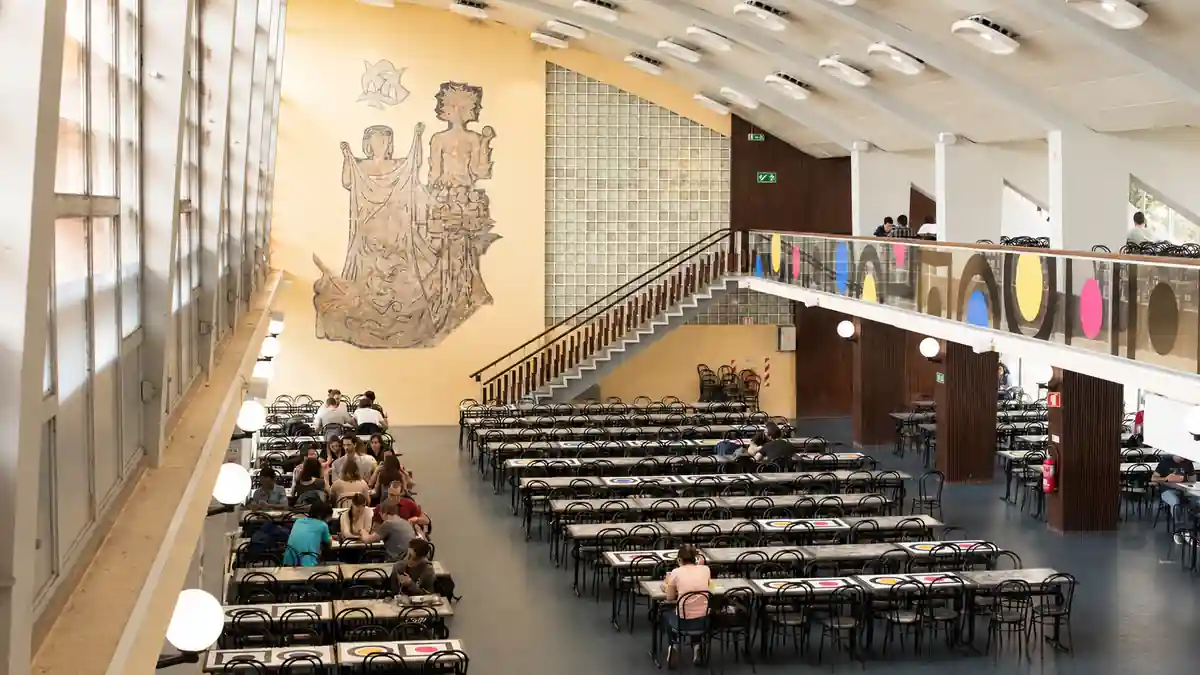

Portugal student meal plan costs are usually far lower than a US-style residential meal plan because Portuguese public universities commonly sell subsidised social meals individually. For a student using a university canteen for one weekday meal, a practical current benchmark is about €48–€62 per four-week month at major public universities, before groceries, cafés, take-away or weekend food are added.
Portugal student meal plan costs are best budgeted as a mix of pay-per-meal university dining and self-catering. Current complete social meals are €2.40 at the University of Coimbra, €2.80 at the University of Minho, €2.95 at the University of Porto and €3.10 at the University of Lisbon. A realistic all-food budget for many students is therefore not “canteen price × 30 days”; it is canteen meals + groceries + off-campus food + snacks and drinks.
What “meal plan” means in Portugal
Most Portuguese universities do not operate around the same prepaid semester meal-plan model familiar from many North American campuses. Instead, the key concept is the refeição social: a subsidised university meal sold through the institution’s social-action services, often known as Serviços de Ação Social or SAS. Students normally pay for individual meals, sometimes after pre-booking or loading credit into a university system.
That distinction matters for budgeting. You are not necessarily committing hundreds or thousands of euros upfront to a dining package. You can choose how often to use the canteen, cook at home, bring food, eat at a faculty snack bar or buy food elsewhere. The canteen therefore acts as a low-cost anchor inside a wider monthly food budget.
The composition of a social meal also tends to be more substantial than the price alone suggests. The University of Porto’s current SASUP price table, for example, says its complete social meal includes soup, bread, a main dish and dessert. The University of Lisbon’s July 2026 guidance describes a complete meal with bread, soup, a meat, fish or vegetarian main, dessert and a drink.
Current university canteen prices: a useful comparison
Portugal student meal plan costs vary by institution, student category and meal format. The figures below are current prices published by the universities or their social-action services and checked on 2 September 2026. They are not a national tariff.
| Institution | Student meal | 20 weekday meals | What to note |
|---|---|---|---|
| University of Coimbra | €2.40 standard; €2.00 for DGES scholarship students | €48 standard | 18 food units; app/card payment; free water |
| University of Minho | €2.80 complete; €2.20 simple | €56 complete | Complete meal includes soup, bread, main, dessert and water |
| University of Porto | €2.95 complete; €2.45 simple | €59 complete | Take-away costs more: €3.65 complete |
| University of Lisbon | €3.10 social meal | €62 | Eight food units cited by ULisboa in 2026 |
Coimbra is especially notable. The University of Coimbra’s SASUC food page currently lists the social meal at €2.40 for most students and €2.00 for scholarship recipients, with 18 food units available from breakfast through dinner across the week. At twenty €2.40 meals, a four-week weekday-lunch budget is €48.
At Minho, the SASUM price table lists €2.80 for the complete student canteen meal and €2.20 for the simple meal. Its grills are a different tier: from 1 September 2026 the fixed community price is €7.50. This is a good illustration of why “food on campus” and “social canteen meal” should not be treated as synonyms.
Porto currently charges €2.95 for the complete student meal inside the canteen and €3.65 for the take-away version. Its simple meal is €2.45 in the canteen. This means convenience itself can carry a measurable premium: twenty complete take-away meals would cost €73 rather than €59.
Planning rule: use your own university’s current SAS tariff, not a Portugal-wide average. Check whether your degree cycle, scholarship status, exchange status or institution changes the price you are entitled to pay.
International, exchange and visiting students: check the tariff category
Do not assume that holding any Portuguese student card automatically unlocks the same subsidised price everywhere. Porto provides a clear example: its current table charges U.Porto students €2.95 for a complete social meal, while students from other public or private higher-education institutions are listed at €5.50 in the canteen. Minho, by contrast, states that its €2.80 complete-meal price applies to first-, second- and third-cycle higher-education students from UMinho and other institutions. Eligibility is therefore institution-specific.
Exchange students should ask the host university how their campus credentials are activated for dining. The same applies to international degree students arriving before a physical student card is issued. Coimbra uses the SASUC GO! app linked to the student card; Porto requires an updated university card for its own student category. These operational details can affect what you pay during the first days of term even when you qualify for the lower tariff.
Students at private universities should also inspect their own institution’s food-service arrangements rather than importing public-university benchmarks. A student residence may offer breakfast or a private dining package, but that is a separate commercial arrangement from the subsidised refeição social described here.
The monthly food budget: three realistic patterns
Portugal student meal plan costs become more useful when converted into behaviour rather than a single headline number. The following ranges are planning estimates, not official consumer-price statistics. They assume a student has basic kitchen access and uses subsidised campus food where available.
Five subsidised campus lunches a week, most breakfasts and dinners cooked at home, limited delivery, and deliberate supermarket shopping.
Regular canteen use, normal grocery shopping, several coffees or snacks each week, and a modest number of off-campus meals.
More cafeteria food, take-away and restaurant meals, branded groceries, frequent drinks and snacks, or limited ability to cook.
The lower end is achievable because staple groceries can still be inexpensive when bought carefully. As a live retail reference rather than an official cost-of-living measure, Continente’s online store showed own-brand long-grain rice at €1.19 per kilogram, twelve medium barn eggs at €2.99 and common semi-skimmed milk multipacks around €0.79–€1.07 per litre when checked. These are examples, not a complete basket, and promotions, city, store format and brand choice can change the result.
A food budget is often lost through small recurring purchases rather than basic ingredients. Two €2.50 café purchases on each class day would add roughly €100 over twenty days. Four €12 delivery or restaurant meals add another €48. A student who focuses only on the €2.80 canteen lunch can therefore underestimate the month by more than the entire canteen bill.
Build the budget from four separate pots
Do not merge these into one vague “food” allowance. The four-pot method shows exactly which behaviour is pushing the budget upward and makes it easier to cut costs without under-budgeting nutrition.
Worked examples for Lisbon, Porto and Coimbra
For a simple comparison, assume twenty weekday campus lunches, €165–€185 of groceries for breakfast, dinner and weekend meals, plus €70 for coffee, snacks and occasional off-campus food. Those grocery and discretionary amounts are illustrative inputs; the canteen prices are current published figures.
Lisbon student
Canteen: 20 × €3.10 = €62
Groceries: €185 assumption
Other food: €70 assumption
Illustrative total: €317 per four-week month
Porto student
Canteen: 20 × €2.95 = €59
Groceries: €175 assumption
Other food: €70 assumption
Illustrative total: €304 per four-week month
Coimbra student
Canteen: 20 × €2.40 = €48
Groceries: €165 assumption
Other food: €70 assumption
Illustrative total: €283 per four-week month
Coimbra scholarship student
Canteen: 20 × €2.00 = €40
Groceries: €165 assumption
Other food: €70 assumption
Illustrative total: €275 per four-week month
These examples show something important: the difference between major university social-meal prices is relatively small in the context of a complete food budget. Moving from Coimbra’s €2.40 standard meal to Lisbon’s €3.10 meal changes twenty lunches by €14. Housing, kitchen access, shopping habits and frequency of eating out can change the monthly total by far more.
How to estimate your own Portugal student meal plan costs
Start with the exact number of campus meals you will realistically eat. If your timetable keeps you on campus four days a week, budgeting for twenty-two canteen lunches every month may be too high. If you have evening classes and a canteen that serves dinner, it may be too low. Use a four-week baseline first, then add a small buffer for longer months.
- Step 1 — Find your university’s social-action food page. Confirm the current student tariff and whether there is a complete and simple meal.
- Step 2 — Check eligibility. Some institutions distinguish by student category, cycle, scholarship status or relationship to the university.
- Step 3 — Check opening pattern. A cheap dinner is irrelevant if your nearest canteen closes after lunch or on weekends.
- Step 4 — Price convenience separately. Take-away, grills, faculty cafés and university restaurants may cost materially more than the social meal.
- Step 5 — Add a real grocery basket. Build it from the foods you actually eat, including fruit, vegetables, protein, breakfast, cooking oil, spices and household basics.
- Step 6 — Add leakage. Coffee, pastries, bottled drinks, delivery fees and late-night food should have their own allowance.
Portugal student meal plan costs also depend on accommodation. A residence with a usable shared kitchen makes self-catering easier. A room with limited fridge space, no freezer, poor cooking equipment or a long commute can push you toward more prepared food even if your theoretical grocery budget looks low. This is one reason food and housing decisions should be planned together rather than separately.
Where students overspend — and where cutting too hard backfires
The easiest savings usually come from replacing convenience, not from removing entire meals. A €2.40–€3.10 social meal is already highly cost-controlled compared with most commercial prepared food. Skipping it to buy an unplanned sandwich, pastry and drink later can cost more while providing less food.
Batch cooking is most effective when it replaces expensive evening or weekend purchases. Rice, pasta, legumes, eggs, frozen vegetables and seasonal produce can form a low-cost base, while canteens can provide variety on class days. If you have dietary restrictions, however, compare menus before assuming the cheapest canteen option will work for you every day. Universities commonly offer vegetarian choices, but exact availability and allergen handling are institution-specific.
Do not build an unrealistically low food budget for visa, relocation or study planning. A spreadsheet can show €150 per month and still fail in daily life if it assumes every meal is home-cooked, no coffee is ever bought, and the student never eats socially. A better budget includes a modest discretionary margin from the start.
Planning study costs beyond food?
Food is only one part of the student budget. Accommodation, tuition, transport, deposits, insurance and immigration costs can be much larger and should be modelled separately.
Contact PortugalPath if you need help structuring the wider Portugal study or relocation budget.
A practical first-month strategy
For the first month, avoid locking yourself into assumptions before you know the campus. Load or activate the university payment system, try the social canteen, identify which units are closest to your classes, and inspect the opening hours. Then compare the canteen with your residence kitchen and nearby supermarket options.
A sensible starting envelope for many students is €300 for food, with permission to move up or down after four weeks of actual spending. In Coimbra or Minho, a disciplined student who cooks frequently may come in well below that. In central Lisbon, a student who buys more prepared food may exceed it. The figure is therefore a behavioural starting point, not a claim that every Portuguese student spends €300.
Track four categories during that first month: university dining, groceries, restaurants/take-away, and café/snacks. If the total is too high, the category breakdown tells you what to change. Cutting two delivery meals may save more than switching supermarket brands across an entire week.
Bottom line
Portugal student meal plan costs are unusually manageable when a student has access to a subsidised social canteen. Current complete-meal prices at major public universities sit around €2.40–€3.10, which puts twenty weekday lunches at roughly €48–€62. The much larger budgeting question is what happens around those lunches.
For a student who cooks regularly, uses the canteen on class days and limits delivery, roughly €190–€260 a month can be a lean planning range. A more flexible pattern with cafés, snacks and some meals out is better modelled around €260–€360. Students who rely heavily on take-away or restaurants should budget higher. Verify your own university tariff before enrolment and again when the academic year begins, because prices, payment rules and opening arrangements can change.
Sources and Verification
- Universidade de Lisboa — July 2026 social-action guidance and current €3.10 social-meal price.
- SASUP, Universidade do Porto — current complete, simple and take-away student meal prices.
- SASUC, Universidade de Coimbra — current standard and scholarship-holder social meal prices and food-unit access.
- SASUM, Universidade do Minho — current canteen, grill and restaurant price table.
- Continente Online rice listing, egg listing and milk category — live retail references only, not official statistics.
Prices and institutional arrangements were checked on 2 September 2026. University tariffs can change, so students should confirm the relevant SAS page before relying on any figure for a future academic term.
Featured photo credit: Universidade de Lisboa / ULisboa, reproduced for journalistic use under ULisboa’s terms with source credit.